GRIEVANCE REDRESS MECHANISM (GRM)
AGENDA
1
Introduction of Grievance Mechanism
2
Grievance Mechanism Throughout Mining Life-Cycle
3
Introduction Vale GRM Process and Discussion
A grievance is an expression of concern or complaint voiced by anyone who feels they have been or will be negatively affected by someone else's activities
DEFINITION OF GRIEVANCE
A resident complains that the walls of his house are cracked due to the construction of a new road and lodges a complaint with the road construction company.
Example Cases
If companies do not pay attention to or downplay any grievances from their stakeholders, disputes will arise and may escalate into conflicts depending on the various local conditions surrounding them.

A person who lives in a company-affected area complains about the lack of transparency in the local labor selection process.
A resident who lives near the PLTU complains about the fine dust pollution that affects the air around his residence.
A farmer complains that his rice fields are polluted by acid mine drainage from coal mining near his fields.
A Grievance Redress Mechanism (GRM) is a formal, locally-based way to receive, record, assess, and resolve and continue learning a community input or complaint.
GRIEVANCE REDRESS MECHANISM (GRM)
GRM is a formal, legal or non-legal (or judicial/non-judicial) grievance handling process that can be used by individuals, workers, communities and/or civil society organizations that receive negative impacts from the operations of a business/company.
GRM is a system through which community grievances and dissatisfaction arising from a company's operations can be communicated, tracked, and resolved in the most efficient manner in accordance with prevailing principles and norms in society.
GRM is an integral part of the company's stakeholder engagement process.
Why need GRM?
For any project with potentially significant impacts - even those managed to the highest standards - community grievances are inevitable.
Companies must have an effective grievance mechanism in place to systematically address and resolve emerging grievances.
Investors understand this and are increasingly emphasizing the need for robust grievance mechanism processes as part of their environmental, social and governance assessment of companies
The effectiveness criteria of the UN Guiding Principles on Business and Human Rights (UNGPs) have become a key international benchmark for implementing grievance mechanisms at the operational level in a way that supports the broader corporate responsibility to respect human rights.
Purpose and Scope
TO PROVIDE A TRANSPARENT, FAIR, AND EFFECTIVE SYSTEM FOR ADDRESSING GRIEVANCES FROM STAKEHOLDERS AFFECTED BY VALE’S OPERATIONS
FOSTER TRUST THROUGH SYSTEMATIC HANDLING OF COMPLAINTS.
IMPROVE OPERATIONAL PRACTICES THROUGH FEEDBACK MECHANISMS.
PURPOSE
Purpose and Scope

SCOPE
- Recording and verifying complaints.
- Developing and implementing resolution plans.
- Monitoring outcomes and improving processes.
Activities Covered
- Complaints from communities, NGOs, government bodies, and other external stakeholders.
- Concerns related to environmental, social, or operational impacts of VALE’s projects.
- Internal Grievance
- Whistleblower from internal or external (illegal, unethical or unauthorized activity)
Included
Internal grievances from employees or contractors, managed via a separate mechanism.
Excluded
Standards and References
Purpose:
Ensure alignment with international regulations and company policies.
- UN Guiding Principles on Business and Human Rights.
- International Council on Mining and Metals (ICMM).
- Initiative for Responsible Mining Assurance (IRMA)
- IFC Handbook – "Addressing Grievances from Project-Affected Communities: Guidance for Projects" (2009)
- IFC Performance Standard 1 – "Assessment and Management of Environmental and Social Risks and Impacts
- Global Reporting Initiative (GRI) Standards: GRI 103: Management Approach
- OECD Guidelines for Multinational Enterprises
International Standard:
- Code of Conduct (POL-0001-G).
- Human Rights Policy (POL-005-G).
- Sustainability Policy (POL-0019-G).
- Risk Management Policy (POL-0009-G)
Key Policies Referenced:
- Socioenvironmental Investment Policy (POL-0024-G).
- Allegations of Human Rights Violations (PGS-003359).
Documentation Standards:
- The UN Guiding Principles on Business and Human Rights (UNGPs)
- ICMM – 10 Principles & Handling and Resolving Local-Level Concerns & Grievances (2019)
- IRMA – Standard for Responsible Mining & Mineral Processing 2.0 (Draft) (2023)
- IFC – Environment and Social Performance Standard – Performance Standard (PS) 1, PS 5 dan PS 7 (2012)
- World Bank – Environment Social Standard (ESS) Framework - ESS 10
- OECD – Guidelines for Multinational Enterprises (2011)
- IFC – Compliance and Advisory Ombudsman, A Guide to Designing and Implementing Grievance Mechanisms for Development Projects (2010)
Performance Standars in GRM Implementation
- IFC – Good Practice Note: Addressing Grievances from Project-Affected Communities (2009)
- The system should provide an access point for complaints to be received and processed and a predictable timeframe for people to receive a response.
- The fairness and effectiveness of the GRM process will determine its credibility in the eyes of users. A GRM can take the form of a simple Excel spreadsheet to a web-based system that can collect daua from SMS, WA, phone, email, verbal remarks and other Uptake channels.
- Reduced likelihood of dispute/conflict escalation
- Early detection of potential conflicts
- Identify and address potential negative impacts, unforeseen issues
- Improve outcomes and mutual learning from resolved grievances
Advantages of this mechanism:

How should GRM be?
TYPES OF GRIEVANCES THAT CAN BE SUBMITTED
Environment - related to degradation of flora and fauna, biodiversity issues, pollution,
Health & Safety - related to public health and safety conditions (e.g., road safety, water pollution, noise pollution, air pollution, waste disposal methods (e.g., fuel spills))
Labor and Employment - related to individual employment, hiring, including contract employees and contractors (e.g., discrimination, sexual harassment, HR policies, workplace conditions, employee remuneration and benefits, access to camp facilities)
Land Claims and Disputes - related to land disputes, land grabbing
Community Livelihoods - related to access, participation and benefits from implemented Community Livelihoods development projects (e.g., access to benefits from PPM programs, dissatisfaction with program benefits)
TYPES OF GRIEVANCES THAT CAN BE SUBMITTED
Whistleblower- reporting or disclosing information regarding illegal, unethical, or unauthorized activities occurring within the organization they work for or elsewhere relevant. Such reporting is usually related to irregularities, violations of law, fraud, or non-compliance with applicable policies and procedures, this can be reported from internal parties or by external parties.
Illegal activities - related to illegal activities occurring within company concessions (e.g., illegal logging, illegal hunting, illegal mining, etc.)
TYPES OF GRIEVANCES THAT CAN BE SUBMITTED
Information - related to access to accurate and timely information (e.g., not receiving copies of information materials and communications, not being invited to community meetings, etc.).
Ethical and behavioral violations - related to misbehavior of company employees, Contractors, Consultants in the community (e.g., disrespecting stakeholders, accepting bribes, physical altercations between workers, company security guards and community members, etc.)
Others - other matters raised as grievances that are considered by the complainants to have caused damage/loss to persons or property due to the company's activities/operations.
Develop Resolution and Action Plan
5
Resolution and Communication
6
Monitoring and Follow-Up
7
Evaluating and Learning
8
1
Grievance Level Assessment, Pre-Identification, and Mapping
2
Receive and Record Grievances
Assessment and Categorization
3
Reporting and Investigation
4
8 Key Steps
of VALE’s GRM
Grievance:
Complaints, allegations, or requests for action regarding the impact of VALE’s operations.
Channels for Submission:
- Online: Email, hotline, web portal.
- Offline: Face-to-face meetings, written submissions.
Key Roles:
- Grievance Administrator (GA): Oversees grievance handling.
- Grievance Committee (GC): Investigates and resolves grievances
Key definitions
Allegation:
Claims of actions contrary to law or company policies.
Complaint:
Requests for action to resolve issues related to operational impact or stakeholder dissatisfaction.
Basic Principles
Core Principles
Transparency:
Regular updates provided to stakeholders.
Equity: Fair treatment for all complainants.
Alignment:
UN Guiding Principles on Business and Human Rights.
International Council on Mining and Metals (ICMM).
Additional Guidelines:
Proportionality, Cultural Suitability, Security
Accessibility: Open to all stakeholders through multiple communication channels.
Continuous Improvement: Feedback mechanisms for learning and adapting.
Governance Arrangements for Grievance Management
- Grievance Administrator (GA):
- Tracks and monitors grievances.
- Grievance Committee (GC):
- Develops action plans and oversees resolution.
- Relevant VALE departments:
- Support implementation and address systemic issues
- Immediate notifications for urgent grievances.
- Regular reviews and audits.
- Integration with VALE’s governance framework.
Governance Structure:
Key Activities:
PLE OF GRM MECHANISM FLOW (ICMM, 2019)
Surel
Surat
Saluran Telefon
Pertemuan
Lainnya
Menerima
(Receive)
Menilai dan Tetapkan (Assess & Assign)
Catat & Akui
Pengaduan dilimpahkan ke departemen terkait : HR; Produksi; Pengadaan; Masyarakat; dll
Menyelidiki & Mengatasi
(Investigate & Address)
Menyelidiki & Mengatasi
(Investigate & Address)
Menanggapi Pengadu (Respond to Complainant)
Penyelesaian Berhasil (Resolve Successfully)
Jika pelapor puas dengan
respon operasi
Banding & Tinjau Ulang (Appeal & Review)
Jika pelapor tidak puas dengan
tanggapan operasi
Pertimbangkan untuk mengadakan Tinjauan Keluhan/ Panel Banding
Menindaklanjuti & Menutup
(Follow up & Close Out)
PLE OF GRM MECHANISM FLOW
Step 1
Receive
Step 2
Record, Assess & Assign
Step 3
Investigate & Respond
Step 4 : Close Out
Level 1 (Within 7 days)
Receive the grievance form
Record & Assess grievance
Conduct investigation with appropriate parties
Prepare proposed resolution
Present resolution to grievant
| GRM Area | Activities |
|---|---|
| Penerimaan Keluhan |
* Tetapkan id email tertentu, nomor telepon. Siapkan "Kotak Saran/Keluhan" yang mudah diakses. * Tunjuk petugas keluhan untuk menerima, mencatata, memantau atau melacak keluhan * Ubah situs web proyek untuk membuat sub-windows permanen yang memfasilitasi pengumpulan keluhan. |
Step 4 : Close Out
Level 2 (Within 14 days)
Step 4 : Close Out
Level 3 (Within 15-30 days)
Step 4 : Close Out
Level 4 (TBD)
PLE OF GRM MECHANISM FLOW
Present resolution to grievant
Grievant satisfied.
Grievant satisfied.
Grievant satisfied.
Yes
Yes
Yes
No
No
No
Refer the grievance to the Grievance Committee
Grievance Committee reaches a decision; Notify complainant of the resolution
Refer to external body / third party
External body notifies [Project] and grievant of decision
Grievant is taken to Court
Close out grievance and update register
VALE's GRM
Process
Step 1 : Risk Assessment, pre-identification and mapping of potential grievance
Step 2 : Receive and recording grievance
Identifying and analyzing potential risks that could negatively impact individuals, assets, processes or the environment that triggers the occurrence of grievances
Identifying all stakeholders who might be affected by the project, including local communities, employees and other relevant parties
Issue identification
Create a grievance category (major, moderate and minor)
Creating visual or systematic representation of where and how these grievance might arise.
VALE provides multiple channels for stakeholders to communicate grievances, including face to face meetings, email, hotline/telephone, writing, online platforms and social media
Grievances can be lodged in multiple languages, including Bahasa, English, Chinese and local languages.
GA will record and update Grievance Master File upon giving notification to the Complainant based on the outcome of initial screening process.
Step 3 : Assessment and Categorization
Step 4 : Reporting and investigation
VALE's GRM
Process
Grievance Administrator (GA) will conduct an initial screening and assessment and record the grievance
Identification of the potential grievances will be performed by GA to identify weather the potential grievances fall under responsibility of VALE or its other institution
GA classify grievances based on their type (e.g., environmental, social, operational) and severity to prioritize responses and analyze based on risk assessment and grievance mapping.
The GA will report grievance to GC
The GC will conduct an investigation to collect information and gather evidence as part of the validation process.
If the grievance is deemed invalid, the GC will inform the GA and the GA will notify the Complainant and update the status to "Closed", or if the complainant is declared valid then it will be countinud to next stage.
Step 5 : Develop Resolution, response and action plan
Step 6 : Resolution/action plan implementation and communication
VALE's GRM
Process
Identify and evaluate potential solutions to address the grievance.
The GC will develop an action plan with GA and VALE unit/department/third parties/supplier that relevant with grievance will execute it immediately updating the GA on the progress.
Implement the agreed-upon solution in a timely manner, ensuring that if effectively resolves the issues.
The GC and GA will coordinate with relevant departments and stakeholders, alllocating necessary resources and assigning responsibilities to execute the action plan efficiently
Once the action plan is fully implemented, the GC will conduct a final review to confirm the grievance is resolved satisfactorily.
The Grievance Administrator (GA) will maintain open communication with the Complainant, providing regular updates on the status of the action plan to ensure transparency.
After resolving the grievance, feedback will be collected from the Complainant to assess their satisfaction and enhance future grievance handling procedures.
Step 7: Monitoring and follow-up
Step 8 : Evaluating and learning
VALE's GRM
Process
The GA and GC will monitor the resolution's implementation to ensure it is effective and sustainable through regular checks and assessments.
The GA will follow up with the complainant to confirm their satisfaction and address any further concerns.
If the complainant is dissatisfied, they can lodge and appeal, which the GC will review to determine its merit and take necessary actions.
The GC will regularly review the grievance mechanism to identify improvement areas by analyzing past grievances and resolutions.
Based on the review, the GC will update procedures, add new tools and provide training to enhance the process
The evaluation process involves monitoring indicators, applying satisfaction surveys, and using the results to improve the grievance mechanism.
After resolution, the GA will update the Grievance Master List and seek the complainant's response to officially close the grievance, creating a quarterly Grievance Summary Report for review.
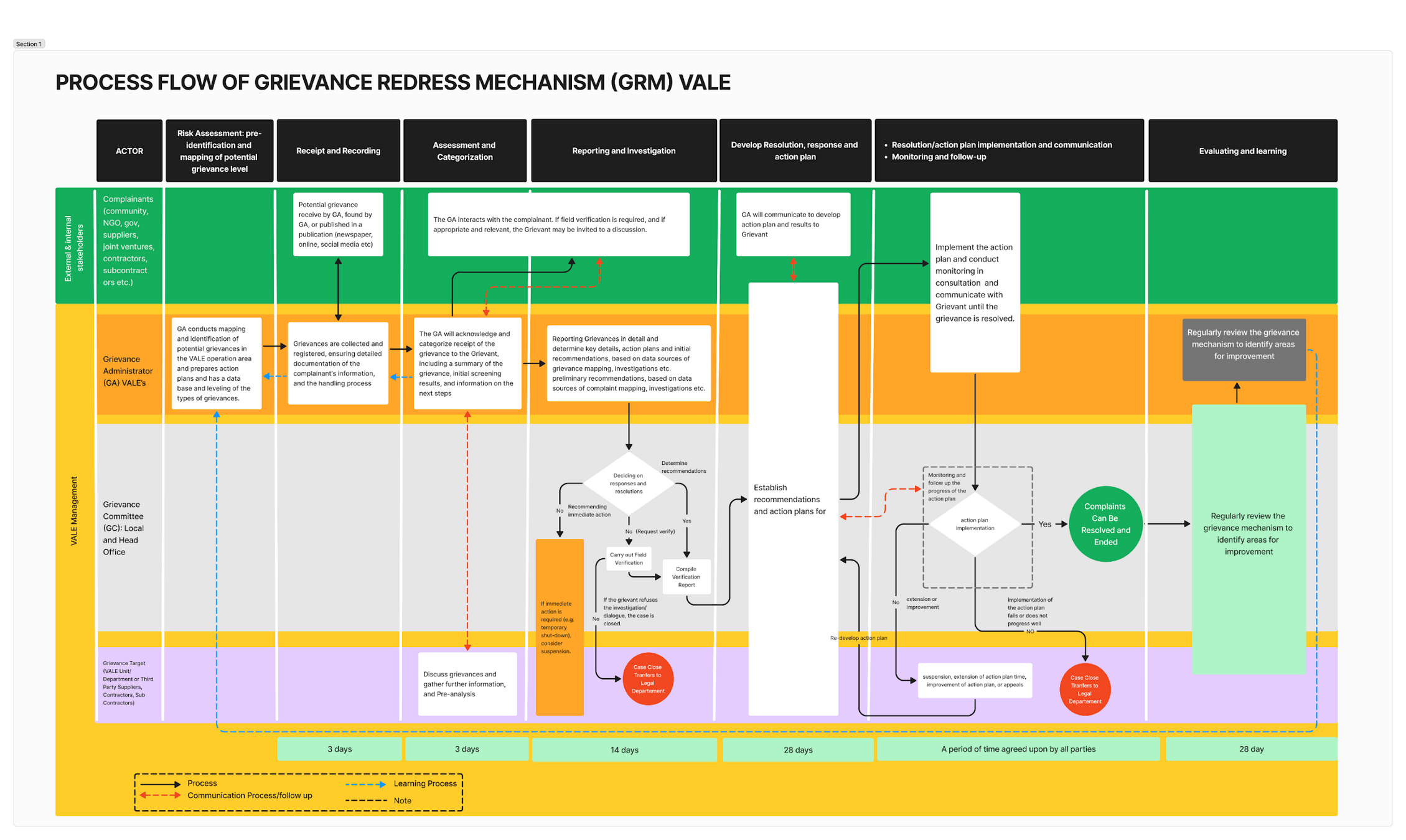
PROCESS FLOW OF GRIEVANCE REDRESS MECHANISM (GRM) VALE
Gap
The mechanism in the old SOP had 6 stages, while in the new SOP it was made into 8 stages.
-
Listening/Capturing stakeholder statements;
-
Systemic Recording to ensure history and monitoring;
-
Analysis and assessment of eligibility, complexity, and type of protest;
-
Answer and feedback to stakeholders with clarity, transparency, and predictability;
-
Treatment and response to protests requiring an action plan;
-
Assessment and monitoring of declarants' satisfaction with the handling of protests and continuous monitoring of indicators.
Old Mechanism
-
Risk Assessment, pre-identification and mapping of potential grievance
-
Receipt and Recording
-
Assessment and Categorization:
-
Report and Investigation:
-
Resolution and Response:
-
Implementation and Communication
-
Monitoring and Follow-Up:
-
Evaluation and Learning:
New Mechanism
Gap
Risk assessment involves identifying and analyzing potential risks that could negatively impact individuals, assets, processes, or the environment. The main goals are to avoid negative consequences and to evaluate possible opportunities of grievance
New additional
Grievance level Assessment, pre-identification and mapping of potential grievance and Continues learning.
Pre-Identification and mapping of potential grievances: This process involves proactively identifying and mapping out potential grievances that might arise during the project
All grievance database use for continues learning and data precision and suggestion for another grievance that coming.
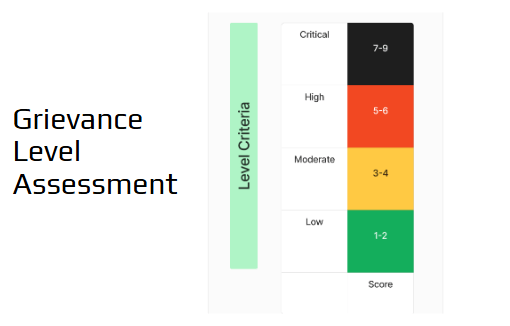
Grievance Level Assessment
COMPANY FAILURE IN GRM IMPLEMENTATION
- GRM is only the domain of the company.
- The company does not position stakeholders as equal partners.
- GRM system that is not internalized in the company. There is no system to assess the level of complaints (by utilizing EIA Sosmap data etc.)
- The level of special attention if the level of complaints is at a critical level.
- There is no continuous learning process in the GRM process by utilizing existing data.
- No participatory involvement of stakeholders, especially the community.
- There is no community-based monitoring. Grievance resolution is only based on the company's attitude and views.
- Does not adopt human rights standards and norms.
- Does not adopt cultural norms and customs of local communities.
- Only sees that the grievance submitted is only related to social issues.
- Difficult to gain access to the results of grievance.
PROSES CONTINOUS DARI GRM
- Early detection of social and environmental risks that impact the company's business risks and community welfare.
- Strengthening the rights of companies and communities as part of citizenship.
- Strengthening harmonious relationships between stakeholders, especially companies and communities in the area of impact of operations.
- Part of transparency and accountability between the company and the community. Part of environmental and social recovery efforts for impacts arising from company operations.
Discussion

Thank You!